Monday, September 27, 1999

Long Gone

I sit at my computer, 1,300 miles away. It is late afternoon now; no, change that -- early evening. Eleven hours at South Fork High School have me mentally exhausted. Homecoming is less than two weeks away. International Baccalaureate seniors are begging for yet another one-on-one review of their 4,000-word extended essays, with their October 1 deadline looming. The classroom, and its myriad of egos and hormone-charged teenagers who think they own the world and all of its riches, is quiet now, serene after another brainswell-soaked day listening to lectures about Oedipus Rex and Fate and Destiny and Steinbeck and Faulkner and Russian literature.

I am planted in front of the monitor, listening via the magic of Internet RealAudio to Ernie Harwell and Dan Dickerson calling the final innings of Detroit Tigers baseball at "The Corner." It is the seventh inning, only a few moments left in the long and established history of the haven where I spent so many wonderful afternoons and evenings during my youth and venture into adulthood. I can recall every moment that I spent at Tiger Stadium the past 35 years, every game, every score, every fleeting moment. Few are of such phenomenal, monumental impact that anyone other than myself might even remotely care about them, but I care all too much, with a passion and a desire that has not left me, despite my flight from suburban Detroit to southeast Florida's Treasure Coast less than two months ago.

I remember the first game I saw. It was a family affair, a Saturday afternoon. The family -- dad, mom, Miriam, Charles and myself -- drive to the cathedral at Michigan and Trumbull and stationed ourselves in the lower left-field grandstands. Next to us in the row were our next-door neighbors, the Varterians. We ate hot dogs and peanuts and cotton candy, drank Coke and tried to keep track of all the action in the 1973 Detroit Tigers program my dad had bought for me. I don't have the program, or the pencil which came with it, but I still have the memories.

It is 6:58 p.m. Ernie has just announced what might be his final home run call at Tiger Stadium, a grand slam by catcher Robert Fick. Ernie's voice crackled as he yelled out "LOOOOOOOONG GONE" in a way which is rare even for the veteran broadcaster. I had the pleasure -- honor, really -- to meet Ernie several times in my career as both a broadcaster and a journalist. The first time was in 1986, while interning at WBFH through Central Michigan University, I secured interviews with Ernie and long-time partner Paul Carey at their individual homes. It was, perhaps, the most incredible and exhilarating day of my radio life. Ernie knew, he could sense, the magnitude of the moment for me, and despite getting in following a late-night flight from Chicago the evening before, was awake and alert and professional and courteous and generous with his time. To this day, I don't know if he realizes how incredibly special that moment was. Then again, maybe he does. I spent over an hour at each of their respective homes, followed by attending the Tigers game that evening against Cleveland with Cindy Stevens, a long-time friend I met at CMU. I got to sit in the broadcast booth for one inning with Ernie and Paul, thrilled by the proximity to the field, overwhelmed by the majesty of the moment.

Cindy was with me in the lower bleachers on a cold Saturday morning, October 13, 1984, when Jack Morris pitched a complete game and Alan Trammell smoked a pair of two-run homers to power Detroit past San Diego 4-2 in Game 4 of the 1984 World Series, the nineteenth (!) time I planted myself in Tiger Stadium that season. The next night, I was driving back to CMU and listening to Ernie when Kirk Gibson blasted one of the most famous -- perhaps THE most famous -- home runs in Tiger Stadium history off Goose Gossage to clinch the title.

Trammell occupies a very special part in my Tiger Stadium memoirs. The "greatest shortstop" to ever wear the Olde English D is entrenched in my mind and soul. It isn't just the two autographed posters on my apartment and classroom walls, the autographed program from his final game as a player, the miniature game figures, even the porcelain baseball card. He represented to me, a young Tiger fan growing up cheering the hometown team, everything that was good about Detroit, baseball and athletics in general. He was, and remains to this day, a class act, which seems to be a rarity in this age of escalating salaries and chronic owner-player bitch-session arguments.

I remember several notable home runs Trammell hit. The World Series pair, of course, stand out. But there was his final home run, on Opening Day 1997, against Seattle. And there was the home run off the Yankees' Cecilio Guante in June 1988, a bottom-of-the-ninth, full-count poke into the upper left-field grandstands which carried Detroit to a 7-6 victory -- one of only a handful (around 20) of down-by-three, last-at-bat grand-slams ever to happen in the history of Major League Baseball. Charles and Kevin Loucks and I jumped up and down for what seemed hours after that thrilling victory. Little did we know that Yankees manager Billy Martin would be fired the next day -- for the final time, or that days later, my father would have surgery on what would turn out to be a malignant brain tumor, effectively ending my elongated career as a naive child grasping to hold on to sports as a magical metaphor for perfection via rose-coloured glasses.

But I still have the memories. Fond memories. I was in the bleachers when Jim Walewander hit his first -- perhaps only? -- shot into deep right-center field against those same Yankees. When Sammy Sosa broke Tiger legend Rudy York's record for most homers in a month, I was planted next to Mark Mosesso along the third-base line. I saw Mark Fidrych talk to the ball, John Hiller on the mound after his career was supposedly over because of a massive heart attack, Larry Herndon's solo shot off Toronto's Jimmy Key which was the difference in the finale against the Blue Jays in 1987. Lance Parrish hit a grand salami during a game I attended but never saw. Sheri Stern and I arrived late at the stadium for a 1985 game against Kansas City, just as a monsoon broke out, and after getting soaked in the upper bleachers for well over an hour we decided to leave, assuming it would end up a rain-out. My first true taste of "never assume;" on the Lodge Freeway, we heard Parrish (who was about to bat when the rains came) drill a moonshot with the bases loaded. Sheri laughed at the incredulousness of the situation; I think I looked like death warmed over, my face contorted into nineteen degrees of disgusted muscle spasms. All of these images, etched in my mind.

I spent happy, bliss-filled afternoons in Tiger Stadium. A July 4 double-header against Baltimore with Todd Skelton, his first -- only -- visit to my own version of baseball paradise. Opening Day with Jeff Falcon and Herman DeBarr. Countless dates, countless friends, all with a common bond.

I was there on a Sunday afternoon in July 1997, when Harold "Prince Hal" Newhouser's number was retired by the Detroit Tigers association. Newhouser, my next-door neighbor growing up, about whom I was blessed to have written my first-ever free-lance story (a feature in Baseball Digest) -- bemoaning his as-of-then non-inclusion in the Baseball Hall of Fame, an oversight which has since been corrected). And there I was, having managed to convince the Tigers brass that I had been approved by their PR department prior to the game for a photo pass (I had, but somehow it got lost in the paperwork), standing with my Nikon camera on the grass between home plate and the pitcher's mound, taking in the magical moment of being firmly planted on the very grass which was my own Field of Dreams, watching Harold Newhouser -- the greatest Tigers southpaw ever -- break into a larger-than-the-universe smile when the banner was finally removed from the upper-right field box area where his Number 16 was unveiled, never to be worn again by a member of the Detroit Tigers Baseball Organization.

And now it is over, the men in blue and orange victorious. As they should be. Over for the shrine which has been my symbolic baseball home for as long as I can remember. The names of the Tigers alumni are flowing over the airwaves: Bill Freehan, Steve Kemp, Willie Horton, Ron LeFlore, Dick McAuliffe, Mickey Stanley, Al Kaline, Dan Petry, Jason "Rooftop" Thompson, Darrell Evans, Jim Price, Gates Brown, Chet Lemon, Aurelio Rodriguez, George Kell, Cecil Fielder, Lou Whitaker and Trammell (together!); so many names, so many memories.

Photographs and memories. To steal a line from Jim Croce, "all that I have are these to remember Tiger Stadium." As the lights dim and the last fan drives away, I sit in silent contemplation of the moment, pondering it all. "It's just a building," one might argue. I bet the same argument held the same lack of water for those who saw the Chicago White Sox move out of the old Comiskey Park, or those who hold Fenway Park and Wrigley Field as their own versions of Baseball Camelot. Tiger Stadium is, and never will be, "just" a building. It is a cathedral of dreams and hopes, of rough times and championships. I will always have fond memories of Tiger Stadium; the final out, thirteen-hundred miles away, cannot take that away from me.

Saturday, August 24, 1996

RV There Yet?

Imagine a life without utility bills. Absent of subdivision association fees. Void of property taxes. Suppose you could visit historical monuments and tourist attractions across the country without ever leaving your home.

For the more than one million Americans who've passed up the life of urban sprawl in favor of traveling the country in their recreational vehicles, this is no fantasy, it's everyday life.

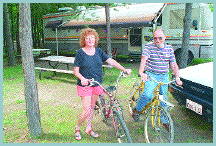
"Home is where you park it," a philosophical Jim Kimmins says of his RV-cum-residence. "We planned this out for eight years, and I think this is even better than we thought it would be," says his wife, Maralyn. The Kimminses, who've been on the road for about a year, used to park themselves in a far more traditional house in Canton.

They're part of a national boom in RV users. Sales of RVs, which for statistical purposes also include towable units such as campers and travel trailers, are expected to soar through the '90s as baby boomers enter the prime RV-buying years, age 45 to 54, according to the Recreation Vehicle Industry Association. According to a recent University of Michigan study, 44 percent of RV owners are 55 and older, while 39 percent are between the ages of 35 and 54.

The concept of living full time on the road is simple: Although far smaller than the average permanent home (the Kimminses' quarters encompass all of 300 square feet), today's motor homes provide comfortable, modern accommodations for their dwellers. RVers have refrigerators, computers, stereo equipment, microwaves and satellite dish-enhanced TVs at their disposal.

What they don't have, though, is what many people don't want anyway: Stress.

"I traveled for Chrysler for 30 years, going from airports to rental cars to hotels," says Jim Kimmins. "There's no Maalox or Tums in this lifestyle. The stress is gone."

Kimmins pauses. "Of course, if you don't like to tow or drive a motor home, then it's stressful - but you won't pick this lifestyle, either. If you want to sit at home and spend your retirement being a couch potato, this is not the lifestyle for you."

Rather, the life of a full-time RVer is nomadic, spent roaming from one campground to another with mostly the basic necessities. It is a chance to get back in touch with rustic America, something foreign to many urbanites.

"We take the back country roads, visit the small, little towns and meet people we've never had the opportunity to meet," Maralyn Kimmins says. "Having lived in the big city for so many years, you find there are things that happen there that don't happen in the smaller towns. Doing this really helps you regain faith in humankind and regain an appreciation for this nation that perhaps a person loses when living every day in corporate life."

This includes going to a local high school football game, participating in potluck dinners, going to band concerts and really becoming immersed in a community for weeks at a time.

RVers also disprove the adage that you can't take it with you. "The big advantage of this lifestyle is that you get to travel and see a lot, but you're also living at home," says Ron Hofmeister, who with his wife, Barb, has co-authored a book about full-time RV living called An Alternative Lifestyle: Living and Traveling Full Time in a Recreational Vehicle, and an RV-lifestyle newsletter, Movin' On. "If you have a house and wanted to do all this travel, it would be (cost) prohibitive."

"We don't have to worry about smoky motel rooms or sleeping in beds other people have slept in," says Barb Hofmeister. "Our home is always with us."

Along with the back-to-nature mentality that many full-timers share is another love: the lower cost of living. Ron Hofmeister, a former deputy finance director of the Michigan Department of Transportation, is considered an expert on budgeting for the lifestyle - and with more than seven years on the road, he has the credentials. He says full-timers pay up to 40 percent less in household expenses than people living at permanent addresses.

Depending on whether you buy new or used, and, of course the size of the vehicle, an RV suitable for full-time living ranges from around $40,000 all the way to $1 million for those bus-size behemoths used by rock stars. The Hofmeisters started out with a $30,000 vehicle and eventually upgraded to a larger, better-appointed model.

Rent, utilities, property taxes, maintenance costs and other fees associated with home ownership do not exist in the world of full-time RV residents. The Hofmeisters' monthly budget of $1,615 has only four major expenses besides their monthly RV payment: $350 for groceries, $300 for recreation or dining out, and $175 each for campground fees and fuel. The fuel is for both their RV and their accompanying Toyota pickup truck, which they use for excursions into town, as it's rather cumbersome to unhook an RV from its site just to go grocery shopping.

Hofmeister says even their budget can be chopped. "There are countless ways to lower campground costs, and $175 merely represents our experience based on a combination of membership parks, commercial campgrounds and public parks," he says.

Some parks reserve sites only for members, such as Smoke Rise, located east of Flint in Genesee County's Richfield Township. Smoke Rise, where the Hofmeisters and the Kimminses recently stayed, is a Coast To Coast campsite, meaning only members of that organization can stay there. Maralyn Kimmins says that by buying a membership prior to retirement and becoming full-timers, their campground costs are covered by $4-per-night vouchers.

The Hofmeisters get more mileage out of their campground budget by either "boondocking" (camping in roadside rest areas, parking lots and other safe and legal places to park) or by volunteering time at public parks.

A common type of public volunteering is called "campground hosting." A campground host is comparable to that of a park ranger proxy, assisting other campers with park information, rule interpretations, campsite selection and even emergencies requiring outside assistance.

Full-timers also pitch in when disaster strikes. When torrential rains flooded the Mississippi River a few years ago, many full-time RV dwellers revised their travel plans and headed to Iowa and Missouri to assist the cleanup effort.

Despite all the positives full-timers experience, they admit there are a few drawbacks. Minor expenses include mail forwarding and voice mail services - essential for full-timers because they don't have a permanent address and rarely hook a phone line into the RV.

"You'd better get used to the world of pay phones. Cellulars are nice - they're OK for emergencies - but they're not cost-efficient for everyday use," Ron Hofmeister says. "Any full-timer will tell you that not having a regular phone is the biggest drawback to this lifestyle."

"We have provisions to hook up a phone line, but the only time we use it is when we know we will be in one place for two or three months," Jim Kimmins says. "We call for messages daily and get first-class priority mail drops once a month."

Adds Maralyn Kimmins: "Because we don't have a phone, I can't access the Internet, which is something I'd really like to do. I feel in a way that I'm missing out on it."

Along with missing direct phone calls from children and friends, some full-timers miss having a permanent church or school system. (You don't have to be a retiree to partake of full-time RV living; younger people have been known to home-school their children.) They also sometimes have difficulty explaining the rationality of selling or giving away their worldly possessions in favor of life on the road.

"We trained our kids in terms of what we're doing," Barb Hofmeister says. "We told them, 'We're not jumping ship and we're not abandoning you. We want to keep in touch and we want you to call, and we will call back. And we will visit you, because our house has wheels."

"Much of our old furniture is divided up among our kids, and whenever we see them there's always a reminder of our former home there," says Jim Kimmins. "Most of our kids handled it pretty well, although we were asked a lot of times by one of our sons, 'Are you done yet?'"

"We know people very close to us who think - and have voiced to us - that what we are doing is absolutely crazy: 'You're so radical! How can you sell your house?'" he adds. "Let me tell you, I've had enough of shoveling snow! I've had enough of gardening! I've had enough of paying property taxes and association fees and getting nothing for it; to heck with that!"

This article originally appeared in The Detroit News.

Wednesday, March 31, 1993

Heads Held High

Wednesday, March 24. Real time said it was 8:59 p.m. But real time is not what the starters, bench, fans or coaches were staring at in disbelief while their lofty dreams faded away like tears in the rain.

Walled Lake Central, an upstart, scrappy, run-and-shoot team which surprised the high school basketball world with its undefeated record and was considered a "sleeper" pick by high school basketball experts, had been a huge underdog to Detroit Pershing. The Vikings had been determined to prove the doubters wrong, but their faithful were now eyeballing the scoreboard hanging over the Calihan Hall hardwood, its light bulbs ticking down toward the inevitable triple-zero formation.

No time. Game over. End of the road.

With it, the Vikings had seen a remarkable campaign come to a sudden end, with defending Class A champion Detroit Pershing using an array of weaponry to wake the sleepers from their dreams. Central had been dealt its first loss of the season, and 89-67 massacre which knocked the Vikings out of the Class A playoffs.

But they didn't go down without a fight. Even with everything the Doughboys threw at them - five first-quarter slam-dunks, a high-pressure defense and a 14-2 run to end the first half which gave Pershing a 48-27 halftime lead - the Vikings kept their heads up and their concentration on the job at hand. After all, wasn't it just eight days prior that Central used a 10-2 run the last 75 seconds of regulation to forge an overtime victory over Pontiac Northern? And then erase a 15-point difference down the stretch in regional finals action to stun hometown Port Huron a few days later?

So there was Central, with more lives than Catwoman, hoping there was still one more trick up its collective sleeve, one more magical performance in its Houdini bag. And the Vikings opened the second half with the word "comeback" etched in their souls, determined to erase the biggest margin they had faced all season and prove to the 4,000-plus fans that they were better than the scoreboard indicated.

It wasn't enough. For every Central spurt, Pershing responded with one of its own. Each Viking feed to Chris MacFarlane drew three Doughboys like a magnet. Central triples clanged off the rim (only 4-of-13 for the game). The flow of Pershing turnovers (and there were a lot of them) was balanced by its suffocating defense. And if the Doughboys weren't blocking a Central shot or playing near-perfect transition offense, they were capping showtime performances with demoralizing dunks.

Perhaps most telling of the way things were going was evident in the crowd reaction to a foul called on Central's Justin Cherfoil with about four minutes remaining. A chorus of boos filled Calihan - from Viking fans upset with the call on one of their boys, and from Pershing followers because the whistle stopped Carlos Williams from completing another uncontested slam.

Tears in the rain. Central, giving up three inches per man to the Doughboys, gave everything it could. But emotion can only carry you so far, and while the Vikings hustled and sweat and pushed and hustled well, Pershing did it better. And as the clock ticked down and the cheerleaders and fans enveloped their heroes, I was reminded of a poem penned by Rudyard Kipling:

If you can dream, and not make dreams your master,
If you can think, and not make thoughts your aim,
If you can meet with triumph and disaster,
And treat those two impostors just the same ...
If you can fill the unforgiving minute,
With 60 seconds' worth of distance run,
Yours is the Earth, and everything that's in it,
And - which is more - you'll be a man, my son!

Congratulations to Coach Steve Emert, his Vikings, and all the Central faithful.

This article originally appeared in the Spinal Column Newsweekly.

Thursday, May 14, 1992

Learning Experience Well Worth Time Here

The only other time I sat down at the computer to pound out this kind of column, circumstances were different. I had been told several hours prior that my sportswriting days at the Marshall Chronicle were through.

My words - jotted out hastily - were a mushy farewell to the community where I had first experienced the joy and wonder of professional journalism.

Someone once told me that, in this business, you'll end up getting fired at least once. Not that it made me feel any better. But I swore the same would never happen again - that next time, the goodbye would be by my own volition, and my words would not be a teary-eyed departure, but rather a thought-out, positive look back at this business and the people I worked with.

Welcome to next time. After more than 22 months in Ogemaw County - an adventure I've come to label "Northeastern Michigan Exposure" - I am moving on to greener pastures.

When I interviewed for this position in June 1990, I had limited background in news writing. My journalism resume contained plenty of sports, light features and humor.opinion columns, but little in the way of hard news.

The Herald's managing editor - a wonderful mentor named Jeffrey Savitskie, whose name I could barely pronounce, let alone spell correctly - had a slew of applicants. That's the way it is in this competitive business. I'm sure many had far more news writing experience, or had more solid credentials on their resume.

But for some reason, he decided to take a gamble and hire me as West Branch's answer to Jimmy Olsen, cub reporter.

And for that I am grateful. What I have learned from this job is infinite.

The newspaper business is very competitive - not just in the hiring process, but a s a whole. There are people who believe journalists "do lunch" with political bigwigs, or have late-night pow-wows to follow party lines and decide just what is and is not news.

Nothing is further from the truth. True, my job as a reporter is to find out the facts. But it is also to "scoop" the competition, to produce a story the other papers - or even other writers at the same paper - don't have. We are elated when we have the inside track, deflated when beaten out on a hot piece.

The competitive edge. Not only is Jeffrey one of the most competent journalistic minds I have ever known, he is competitive. Like most journalists, he hates to be burned by the competition.

But there is more to Jeffrey than this. He is quick to suggest different angles on stories or point out flaws in writing technique. He can play "devil's advocate" with anyone on any topic, and do it well.

Jeffrey has an uncanny ability to analyze his workers individually, to know their limits and push them as hard as they can if they are not reaching what he feels are attainable goals. From personal experience, this can be frustrating ... mostly because if I'm not reaching those limits, I'm not sure who is harder to deal with - him or myself.

Jeffrey is also one of the most honest, fair people I have come across - qualities which make him not only a fine journalist, where being unbiased and honest are essential, but a fine human being.

I have been very lucky and fortunate to learn as much as I have from him in this business, a serious business where we are paid to watch history happen, write about what we have seen, heard and smelled, then do it again tomorrow.

And that's what counts. Today's story might be a Pulitzer winner. Or maybe it was a "no-brainer." It doesn't matter, because the news business is not about today - it's about tomorrow. In this business, no one is any better than what they will do tomorrow.

And for me, tomorrow is a whole new frontier, a vista waiting to be discovered. Ogemaw County, thanks for tolerating me and allowing me to be part of you - if only for a little bit.

This article originally appeared in the Ogemaw County Herald.

Thursday, May 7, 1992

Moms Should Top "Most Beautiful" List

People Magazine has published yet another edition of what it perceives as the world's "Most Beautiful People." What everyone seems to realize - without saying as much - is that the headline and ensuing photostory are not quite accurate.

"Most Beautiful Celebrities" would be more appropriate. This edition is filled with mini-essays and pictures of movie stars and pop singers.

Yes, they might be beautiful. Certainly on the outside, possibly in their souls. But are the people People named the world's Most Beautiful indeed the most beautiful? Everyone has their opinion. Mine is I don't think so.

I say this because one of the most beautiful women I know somehow failed to catch the editor's eye.

My mom.

Maybe she hasn't starred in blockbuster movies or hit Number One With A Bullet. That's OK. I didn't realize these were prerequisites for being beautiful.

They're not.

What makes Mom beautiful? Well, for starters, she took on a pretty difficult assignment when she became a mother. Especially since I was the first born, the oldest of three.

As many people have commented, raising a child is on-the-job training with no instruction book or corporate policy. While I do't remember a lot about my infant years, I think there could have been easier first babies to raise than me.

But this isn't about me, it's about Mom ... even though I couldn't write this without being a part of the story. After all, this is my perception.

What else makes Mom beautiful? She makes excellent chicken soup. The best. The type that head honchos at Campbell's would taste and say, "Hire her at any cost!"

If there were chicken soup cooking contests at county fairs, Mom would be the uncontested Chicken Soup Queen.

Mom also made the best Friday Night Sabbath Dinner this side of Jerusalem. Yes, it was predictable: chicken, wild rice, mashed potatoes and plenty of iced tea. But it was the sort of "predictable" we Gabas thrived on.

There's more to Mom's beauty than cooking, though. I think the biggest, most important, definitely most beautiful part about her is, she's been with me when I need or want her.

Mom has shared my triumphs - such as my Eagle Scout Court of Honor and graduation from high school and college.

She has been part of my daily routine, from homework and driving me to youth group activities to attending orchestra concerts and Little League baseball games.

In times of difficulty - and there have been far too many - Mom has been there to ease the pain.

Mom has been there for me, whether as a shoulder to lean on or an ear to hear my complaints. She and Dad reared their children in a loving, caring atmosphere, always showing attention to their children and never ignoring even the most minute details.

Mom has lived up to the very difficult job requirements of being a mom.

I can't be in Detroit to help Mom celebrate Mother's Day No. 28 this Sunday. But I raise a glass and offer a toast to her, and all other mothers who are at the top of their children's Most Beautiful lists.

Happy Mother's Day.

This article originally appeared in the Ogemaw County Herald.