Monday, January 7, 2019

The Politics Of Dancing

There's a strong, logical belief that personal political philosophies are shaped by the family structure - that children of liberal-leaning parents vote accordingly, and those of conservative parents identify as such.

This makes sense. Like other life skills formulated in our early years, it's the parental unit which sets the standards and expectations, whether it be religious ideals, intimacy levels, critical thinking, communication skills, aggressiveness, literacy, or how one deals with relationships (personal and professional).

But for many, personal political stances do not remain stagnant. As we mature and develop, and are introduced to new or different ideas and ideals, these positions can shift. Where one lives, who one befriends, the types of education and educators to which one is exposed, financial shifts, a partner's beliefs - can, and often do, influence how we see the world.

This isn't always true, obviously. I know people who have never shifted their political ideology in 50 years, hard-liners who are unwilling or unable to even consider change. I know others that have turned 180 degrees from their parents' political views, and can only imaging the dinner table discussions at Thanksgiving. I know some liberals who have shifted more to the left, conservatives who are much farther to the right, some whose political stances change more often than Michigan weather, and some who have zero interest in politics whatsoever.

For many, their first concrete political memory may have been something dramatic that took place during their youth. It might have been a major event, such as the assassination of John F. Kennedy or the Iranian Hostage Crisis. It might have been a political corruption issue, such as Watergate or the Bill Clinton impeachment hearings. It might have been a mock voting booth during elementary school, or a war which impacted family or friends, or parents running for office.

I grew up in a fairly liberal family environment. My earliest political memories revolve around the Vietnam War, which had (and continues to have) a huge influence on how I viewed the world. I remember my father hanging a homemade peace flag (black marker on a white bedsheet, I believe) alongside the American flag in the late 1960s, when we lived in Pontiac, Michigan.

A few years later, after we'd moved to neighboring Bloomfield Township, he participated in the January 20, 1973 anti-war march on Washington, D.C., where more than 100,000 demonstrators marched on the nation's capitol during President Richard Nixon's second inauguration. I remember our family sending him off on a Greyhound bus, and recounting the experience after he'd returned home, with photos and tape-recordings of protestors singing anti-war songs to and from the Lincoln Memorial. Sadly, the family photos, recordings, notes, and other materials related to the "March Against Death" have been lost, but the memories remain.

Since then, I've been both passively and actively involved in politics. I became a conscientious objector, and attended many meetings with others who were opposed to war. I watched and listened to broadcast news reports. In 11th grade, I campaigned for Republican-turned-independent presidential candidate John Anderson, for three reasons: (1) my history teacher offered extra credit to the class as part of a 1980 election project if we worked on a campaign; (2) I thought the local Royal Oak office's secretaries were more attractive than those of Republican Ronald Reagan's or Democrat Jimmy Carter's offices {I was 16; that was kind of a big deal}; and (3) I related to his political stance.

Yeah, that was kind of important, too.

As the linked obituary above notes, even though he was aligned with the GOP, Anderson was liberal (possibly the most of the three) on social issues - he supported gun control measures and abortion rights. Fiscally, he was conservative. He was opposed to right-wing extremism. While campaigning, he received heavy support from college students, bucked the establishment, and was seen as a "thorn" in the sides of the "chosen" candidate.

In the grand scheme, I related to him far better than I did to Reagan or Carter.

I still do.

We've see similar adjustments in political indoctrination the past few years. In 2016, Bernie Sanders (to a degree) pulled an Anderson, electrifying the college crowds and challenging the Democratic Party establishment. This past November, young women (many of color) won political office and have put a wrench in the seemingly tired Washington, D.C. governmental process. Newcomers like Rashida Tlaib, Alexandria Ocasio-Cortez, Deb Haaland, Ayanna Pressley, and Ilhan Omar, are turning heads and making waves, and in turn are making young adults look deeply at their own political viewpoints.

Over time, I've voted - and campaigned - for conservatives and liberals. I've voted for the establishment and the rebels. I've written in names on ballots (including my father, for Michigan governor, in 1986). When I was a political journalist in the 1990s, I maintained a "no political party" stance (I wrote about this a few years ago), and regularly attempted to let the story tell itself and allow voices from various political platforms comment on the topic of choice.

As a high school debate teacher, I want my students to engage domestic and international topics from multiple viewpoints, and play devil's advocate regularly. In my Introduction to Film and Entertainment class, I show movies that often have political stances and philosophies embedded in the plot - sometimes below the radar - and offer students the chance to think about their role in the world and how their political philosophy can be enhanced. When I taught English, I introduced works by Chaucer, Orwell, Faulkner, Garcia Marquez, Chopin, and many others, often infused with political or philosophical messages for students to ponder, discuss, debate, and write about.

Last year's tragedy at Marjory Stoneman Douglas High School - located only about half an hour from Wellington High School, where I've taught since 2002 - added to the young adult political activity that has been becoming stronger the past decade. As I noted then, we want - and need - young adults active on all sides of the political arena.

As both a journalist and an educator, I believe my job has been, and continues to be, to present the information and let the consumers (readers and students) analyze the data to form their own informed, viable position.

But I do have my own political philosophy, and it aligns closely (but not 100%) with the Democratic Socialists of America platform. What do I mean? For 2020, I am supporting candidates with clear plans to promote:

  • Shared prosperity and a jobs guarantee.
  • Equal rights and protection from domestic and public violence.
  • Sensible gun violence prevention.
  • Affordable comprehensive healthcare for all.
  • Free public higher education.
  • A reduction in interest on college loans AND/OR forgiveness of college loans taken out prior to 2010.
  • A sustainable planet.
  • Support for a free and independent press.
  • Ending voter suppression while promoting free/fair elections.
  • Decreasing the influence of money in politics.
  • Immigration justice.

Notably absent from this is the DSA's position on the Israeli-Palestinian conflict. While the DSA supported Israel throughout much of its history, including socialist and progressive individuals and movements, in 2017 it endorsed the Boycott, Divestment and Sanctions movement. I wholeheartedly disagree with BDS and believe it to be a misguided and counterproductive measure to resolving Middle East issues (in part because sanctions of any sort have been proven rarely effective, and when they appear to have worked, it's unclear if the sanctions were the deciding factor).

{Sidebar: I fully support Israel, and understand what the BDS movement is attempting to achieve, but disagree with its methods. At the same time, I'm opposed to legislative efforts to suppress free speech (and choosing to do business, or not to do business, with others is a free-speech option). Efforts to silence BDS supporters are as misguided, IMHO, as the movement itself. Legislative attempts to penalize or criminalize BDS activities is not a way to achieve open discussion, conversation, and debate of the issues. It is counterproductive to resolution of a very complex issue.}

Like I said - close, but not 100%.

I've never bought entirely into a specific political platform, and probably never will. And I have no problem with that. I plan to research where each candidate stands on these values. I’m not going to engage in in-fighting or relitigating 2016. I’m focused on the issues, and each of the candidates’ ability to make change and to win the election.

So may we all.

Friday, January 4, 2019

No Trump Thursdays

Last month, I made a number of resolutions heading into 2019.

One of the more interesting ones was to make my Facebook Thursdays "Trump-free" zones.

"Because I am trying to clean up some of the toxins from my life, THURSDAYS will now be NO TRUMP THURSDAYS on my Facebook wall. I won't post anything Trump. I'll delete Trump posts by others. #NoTrumpThursdays," I proudly proclaimed on December 23.

The general consensus was that, given my online political posturing, this might be one of the resolutions first to fall. I couldn't really argue the idea; I knew, once I posted it, that maintaining the resolution would be extremely difficult.

But it was worth a shot.

Yesterday was the first test of this resolution. And it was challenging. After all, it was the day new federal elected officials were sworn in, and Nancy Pelosi re-took the U.S. House of Representatives majority speaker position, and Donald Trump held an impromptu press conference where nothing happened.

And, of course, the government shutdown was a hot topic, with the Democrats holding their line of "no border wall money" and the Republicans saying "We'll keep the government shut down until Hell freezes over!" (Or words and actions to that effect.)

All this was capped with an amazing Dance Fever viral video featuring freshman U.S. Rep. Alexandria Ocasio-Cortez doing her best Ally Sheedy imitation whilst attending Boston University a decade ago. I mean, all I know is, any dance moves I make that end up going viral would not only end any opportunity for me to win public office, but would make babies cry and make women cower in fear.

(Sidebar: the more I learn about AOC, the more I like her. I don't know how effective she'll be at politics, but she brings fresh energy and a wonderfully positive attitude into an arena essentially void of both these qualities. And she's got the establishment from both major parties on their heels. Welcome to the New World Order!)


So, yeah ... it was challenging. But it was achieved. Nary a mention of the POTUS on my timeline. For a brief moment in time, he ... did ... not ... exist.

And the world was a better place.

One down, many to go.

Now, to make Sundays, Mondays, Tuesdays, Wednesdays, Fridays, and Saturdays Trump-free ... THAT would be a challenge of epic proportion.

Thursday, January 3, 2019

We Are Not Alone

While Rep. Alexandria Ocasio-Cortez and the rest of the 116th U.S. Congress were being sworn in today, there was plenty of dancing and celebrating taking place on Capitol Hill. But ironically, the dancing that received most of the attention on social media was footage of the freshman Bronx politician performing the dance from The Breakfast Club while attending Boston University several years ago.

Yesterday, a Twitter user named Dan Jordan posted a 31-second edited excerpt from a much longer 2010 BU promotional video. The rationale, I suppose, was to somehow damage AOC's reputation.

Here's the 31-second "Best of AOC" clip:


And here's the full-length video:


The original video was filmed for BU's Howard Thurman Center for Common Ground, to showcase the vibrancy and spirit of their community. And while there appears to be nothing remotely scandalous about the video, that hasn’t stopped right-wing Twitter users from attempting to weaponize it against AOC. Since winning her election in November, the Democratic Socialist has been criticized about a variety of seemingly minute issues, from the clothes she wears and her bank balance, to her modest childhood home, and - now, apparently - for dancing and having fun while in college.

She is, for lack of better words, a lightning rod.

She is also, for lack of better words, seemingly quite capable of turning every attack against her opponents quickly and effectively.

AOC is a quick study on how to "give no fucks" on the national scale about what elders think about her generation.

This is not the first time a young adult thrust into the public eye has schooled the establishment. The Marjory Stoneman Douglas High School survivors (Alfonso Calderon, Sarah Chadwick, Jaclyn Corin, Ryan Deitsch, Emma González, David Hogg, Cameron Kasky, and Alex Wind) have put on a clinic the past 11 months, refusing to stand down when taking on the National Rifle Association or U.S. Sen. Marco Rubio on national television.

Now, I realize dancing talent (and AOC and her fellow BU Terriers have some pretty decent moves) isn't quote on par with political commentary and being part of the U.S. House of Representatives - but then again, taking the John Hughes template and using it as your standard is a pretty good way to let loose and connect with the voting populace (even if that wasn't her intent eight years ago).

Ally Sheedy, who starred in the original The Breakfast Club, and who was seemingly AOC's inspiration, chimed in on the performance.


Brat Pack and The Breakfast Club co-star Molly Ringwald followed suit:


Luckily, no one fell through a false ceiling. And no one has accused AOC of raiding Barry Manilow's wardrobe. Yet.

Conservatives who obsessively comment on AOC's dance video and attire (among other non-political topics) feed directly into the narrative that the right is anti-women and doesn't treat them seriously. It’s counterintuitive to what the GOP is trying to do, and backfiring … oftentimes spectacularly. What's worse, these are her strengths, her positives - being a young adult with a sense of style and purpose is a good thing. It makes her look attractive, fun, and relatable - personality quirks that are really good to have in your political toolbox.

If it's a personality contest, AOC is winning, hands down.

The GOP is scared of what Ocasio-Cortez brings to the table. They don’t like her policies or positions. If they really wanted to try and take her down a peg or two, they should can the personal attacks and focus on her political ideas instead. Among other things, she supports progressive policies such as Medicare for All, a job guarantee, tuition-free public college, ending the privatization of prisons, and enacting gun-control policies. She campaigned in favor of tuition-free universities and public schools. AOC is a self-described hardliner on environmental issues, calling climate change the "single biggest national security threat" facing the United States, and calls for a Green New Deal in the United States, in which the federal government would invest in the construction of large-scale green-infrastructure projects. Republicans should try and explain why they believe her stance is unaffordable and unworkable. (I’m not sure how effectively they can do so, but they aren't even trying right now.)

Meanwhile, there's still a stalemate in Washington, D.C., in terms of the government shutdown over President Donald Trump's border (or boarder) wall's non-Mexican funding. That's not much to dance about, in the grand scheme of things. We shall see what transpires under the new Democratic-controlled House of Representatives.


What might the Breakfast Club say about their new worldly discoveries?
Dear Mr. Vernon: we accept the fact that we had to sacrifice a whole Saturday in detention for whatever it was we did wrong, but we think you're crazy to make us write an essay telling you who we think we are. You see us as you want to see us, in the simplest terms and the most convenient definitions. But what we found out is that each one of us is a brain ... and an athlete ... and a basket case ... a princess ... a criminal ... and a United States Representative from New York's 14th Congressional District. 
Does that answer your question?

Thursday, March 15, 2018

Never Again

I was bullied in elementary school - physically, verbally, mentally, psychologically.

I was bullied in junior high, high school, and college as well, via one or more of the previously mentioned methods.

I was physically assaulted - mugged - my sophomore year in college. Woke up in a hospital 48 hours later (coma was induced, I think) with a skull fracture, blood clot in my left ear, deviated septum, shattered nasal passage, partial vision in my left eye.

I've suffered bouts of depression, sought professional help multiple times, and have hated myself and/or the world around me at times.

I have trust issues, and probably carry a lot of unseen/unheard baggage I'm either unwilling or unable to admit.

And through it all - over the past nearly 54 years - not once have I ever contemplated buying a weapon and using it to attack others.

Having said this ...

I am not a gun owner, but have fired guns before. I have no problem with guns being owned and used by properly trained individuals, who understand the danger they can (and often do) pose to society. Just don't force me to carry a loaded firearm, or to be around loaded firearms, as part of my public school employment.

I have no problem with the idea of background checks before purchase, because I believe anyone who chooses to purchase a weapon should be mentally competent. I also believe background checks would not completely eliminate bad guys getting guns or completely eliminate mass shootings. But they would help.

I do not believe background checks violate our constitutional rights. While many voice the "slippery slope" argument, gun control doesn’t need to involve confiscation. Something as simple as licensing and requiring an understanding of how to use it could reduce gun violence.

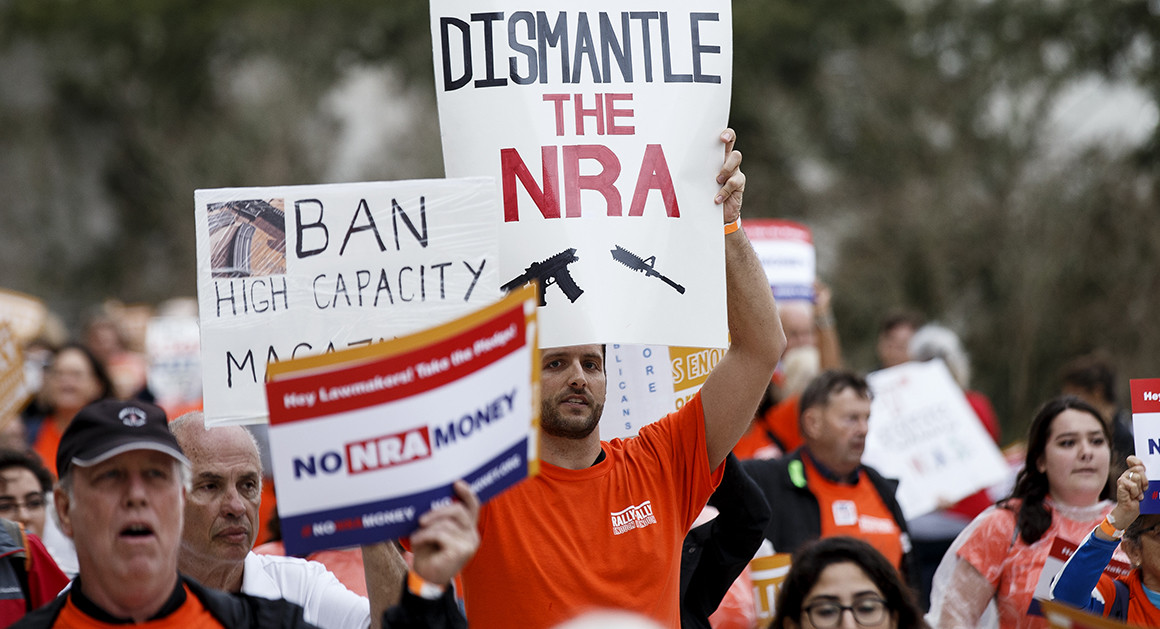
I believe the National Rifle Association is doing a disservice to both its membership and all other citizens through its political posturing, and that its failure to endorse common sense controls on both who can own weapons, and what types of weapons should be owned by the populace, is doing the organization more detrimental harm than good.

I believe the Second Amendment does not outweigh any other amendment to the Constitution of the United States, and I fully support students incorporating their First Amendment rights and speaking out in peaceful assembly to change the ways our nation thinks about guns.

I'm proud of yesterday's Wellington High School student-led 17-minute on-campus "Walk IN," to recognize those that lost their lives in last month's senseless and horrific day at Stoneman Douglas High School. It was truly "unchartered territory" and went as smoothly as one could hope. It was voluntary; my students were not forced or coerced to participate in any way. 

(There may have been some students who took it as a "day off" mentality, or at least a "cut a class" mentality. I'm not so naive as to think otherwise. But from what I observed and have heard from fellow faculty, the vast majority took it seriously, and are out to prove they have a legitimate voice in the process.)

I'm proud of yesterday's "Day of Action" on the campus of Wellington, where students were (again, voluntarily) able to donate blood, register to vote, or hear our elected officials speak in the Lecture Hall. We had Sen. Kevin Rader, Rep. Matt Willhite and a Special Assistant to U.S. Rep. Lois Frankel at scheduled times during lunch. And we had branches from our Armed Forces set up throughout the courtyard for students interested in how they can serve our country.

When I was in high school, I became politically active for a number of reasons - my father's active opposition to the Vietnam War; my own formation of being a conscientious objector; my volunteering for the John Anderson presidential campaign. I'm proud to see today's young adults becoming politically active as well. We want and need young adults involved in the political arena. On all sides of the political arena. We are at our best when we can have passionate, educated arguments from multiple viewpoints and find common ground for the greater good. I believe despite the current mood in our nation's capital, there is still opportunity for teamwork.

They are the future. They are our future.

Sunday, February 25, 2018

What if?

A few days ago, my friend Jim Pastori asked me a very legitimate question on facebook in light of the ongoing debate over arming educators after Stoneman Douglas"

"Just to play devil's advocate (no pun intended), if it was your kid under siege, would you want an adult (teacher, administrator etc..) with a gun to help defend them? I am not a proponent of this plan - but I try to see all sides…."

The easy cop-out: I don't have any children! (But I do have three nephews, and I have 150-175 young adults under my care daily during the school year. I'm their proxy parent when they're in my classroom.)

The easy response: Of course! Anything to save my child!

The realistic response: So this is the world in which we now live, where calling for entrusting educators with both buying and taking bullets are part of the norm. While it sounds good at face value, there are so many problems with this “solution” that it’s hard to decide where to begin.

The logic is pretty simple, according to Oregon Secretary of State Dennis Richardson: "If I had been a teacher or the principal at the Sandy Hook Elementary School and if the school district did not preclude me from having access to a firearm, either by concealed carry or locked in my desk, most of the murdered children would still be alive, and the gunman would still be dead, and not by suicide." And after Sandy Hook, Florida State Sen. Dennis Baxley said, "In our zealousness to protect people from harm we've created all these gun-free zones, and what we've inadvertently done is we've made them a target. A helpless target is exactly what a deranged person is looking for where they cannot be stopped.”

The main problem with this entire debate is that every "arm teachers so they can get the 'bad guy' before he (because it's never a 'she') can fire upon your students" looks as this as a one-size-fits-all answer. I know the plan is that teachers should only shoot the individual(s) who are trying to kill them, but it’s difficult to imagine teachers would do a better job of it than, say, professional LEOs or military. You know, individuals with thousands of hours of professional training. And even with that, there's the risk of friendly fire, casualty of war, or collateral damage. (Speaking of which, should educators prioritize sharpshooter training over lesson planning or grading assignments? There are only so many hours in the day.)

Arm the teachers, save the kids. It's a myopic, narrow-minded view that looks at a single scenario. And it makes a lot of assumptions along the way, in particular that my carrying a revolver (while on the defensive) will somehow make me capable of handling someone with a much more powerful weapon (who is on the offensive). That four armed LEOs failed to even venture into the building where students at Stoneman Douglas High School - were they strategizing? Waiting for more backup? Scare shitless? - is a huge red flag.

Regardless of whether I am armed or not, here is my "priority list" for keeping students as safe as possible in ANY situation that might involve an active shooter:

1: Ensure the doors to my classroom are locked. (Note: Mine are ALWAYS locked.)
2: Ensure shades are drawn on exterior windows.
3: Lights off.
4: Get students into one of the two storage closets in my classroom (both have art supplies and other items, but the two combined can house around 40 students).
5. Cell phones on SILENT (I mean, the ringers should be off anyway, but just to be sure).
6. Maintain silence as long as possible.

Please note that nowhere in there are the phrases "Grasp my hand around a weapon on my hip" or "Try to remember the code to my classroom gun safe" or "Abandon the class to go hunt down a shooter" or anything of the sort.

The myopic part of this discussion is that it fails to take into consideration all those other school days where there isn't an active shooter scenario, and bad things can happen with guns in a classroom environment.

First, arming a militia of teachers may only serve to give students and faculty a false sense of protection. Furthermore, it may actually be counterproductive toward instilling an atmosphere of learning, respect and safety, all of which are vital for education. I mean, on the hypothetical bright side, it may increase good behavior among students, though this good behavior would be more out of fear than respect for the rules. But rather than feeling safe and protected, the idea of armed teachers and staff has the potential to be, at the least, strongly disconcerting to the average student, and at worst downright terrifying.

There's the possibility of teachers "going postal." Don't laugh, it can happen. Or teachers who believe (justifiably or not) they are in an unsafe classroom environment.

There's the "students can overpower teachers and steal their weapons" issue.

There's the liability issues - if I (accidentally) shoot a student or two, whether during an active shooter or not, who gets sued? The school? The district? Me?

There's the the finances of this idea. I find this point particularly offensive - that having failed to adequately fund teacher salaries, pensions, and supplies the past decade-plus, suddenly our federal and state governments have an abundance of cash to create small militia in schools. Our government is telling us it can find the funds for guns, ammo, and training? And will body armor be included, or is that out-of-pocket? And if out-of-pocket, are all of these expenses deductible on my tax forms? (Hint: like everything else in government, it would become unfunded mandates, which means either higher taxes or less money for the supplies already underfunded ... or both.)

I really don't want to receive a Kevlar vest for my birthday (or ever), but given the choice, I'd take that over a gun.

According to a May 2012 poll conducted by Republican pollster Frank Luntz for the group "Mayors Against Illegal Guns," gun-owning Americans, including National Rifle Association members, overwhelmingly support a raft of common-sense measures typically described as “gun control.” These include:

- Requiring criminal background checks on gun owners and gun shop employees;
- Prohibiting terrorist watch list members from acquiring guns;
- Mandating gun-owners tell the police when their gun is stolen;
- Concealed carry permits should only be restricted to individuals who have completed a safety training course and are 21 and older; and
- Concealed carry permits shouldn’t be given to perpetrators of violent misdemeanors or individuals arrested for domestic violence. (The NRA/non-NRA gun-owner split on these issues is 81 percent and 75 percent in favor of the violent misdemeanors provision and 78 percent/68 percent in favor of the domestic violence restriction.)

The burden of societal ills is often placed on the shoulders of teachers today. It’s not fair, or reasonable. But we teachers have sadly become accustomed to it. We get it. We are proxy parents. In some cases, we're the parents students wish they had. And the vast majority of us do NOT believe moonlighting as soldiers or first responders solves more problems than it creates. Instead, search #armmewith to see what we really need to help all of our kids.